Even in climate-controlled offices or seemingly dry commercial interiors, ambient moisture can silently compromise the performance and longevity of Acoustic Wall Panels. Unlike visible water damage, subtle humidity fluctuations cause gradual delamination, binder degradation, and absorption loss—eroding sound attenuation without obvious signs. For procurement professionals and project managers overseeing fit-outs or renovations, overlooking this hidden risk may lead to costly mid-life panel replacements or acoustic compliance failures. This article reveals how moisture exposure undermines Acoustic Wall Panels behind the scenes—and what specifiers and decision-makers can do to ensure long-term performance, durability, and ROI.
Why ‘Dry’ Interiors Aren’t Dry Enough for Standard Acoustic Panels
Relative humidity (RH) in many office buildings, retail spaces, and educational facilities routinely cycles between 40%–65% — well within ASHRAE’s recommended comfort range, yet high enough to accelerate hydrolytic breakdown in organic binders used in fiberglass, mineral wool, and recycled PET panels. Over 12–24 months, repeated RH swings above 55% can reduce NRC (Noise Reduction Coefficient) by up to 0.15 points — a measurable drop in speech privacy and reverberation control.
Delamination isn’t always visible. It begins at the micro-level: moisture swells cellulose fibers, weakens phenolic or urea-formaldehyde resins, and disrupts fiber-to-fiber bonding. The result? Reduced mass density, compromised air flow resistance, and diminished low-frequency absorption — especially critical in open-plan offices where bass-rich HVAC noise dominates.
Project managers often discover the issue only after commissioning tests fail — or worse, during post-occupancy complaints about echo, voice leakage, or inconsistent acoustic zoning. Retrofitting at that stage typically costs 3–5× more than upfront specification due to labor rework, schedule delays, and disposal fees.
How Moisture Impacts Core Panel Components (and What to Check)
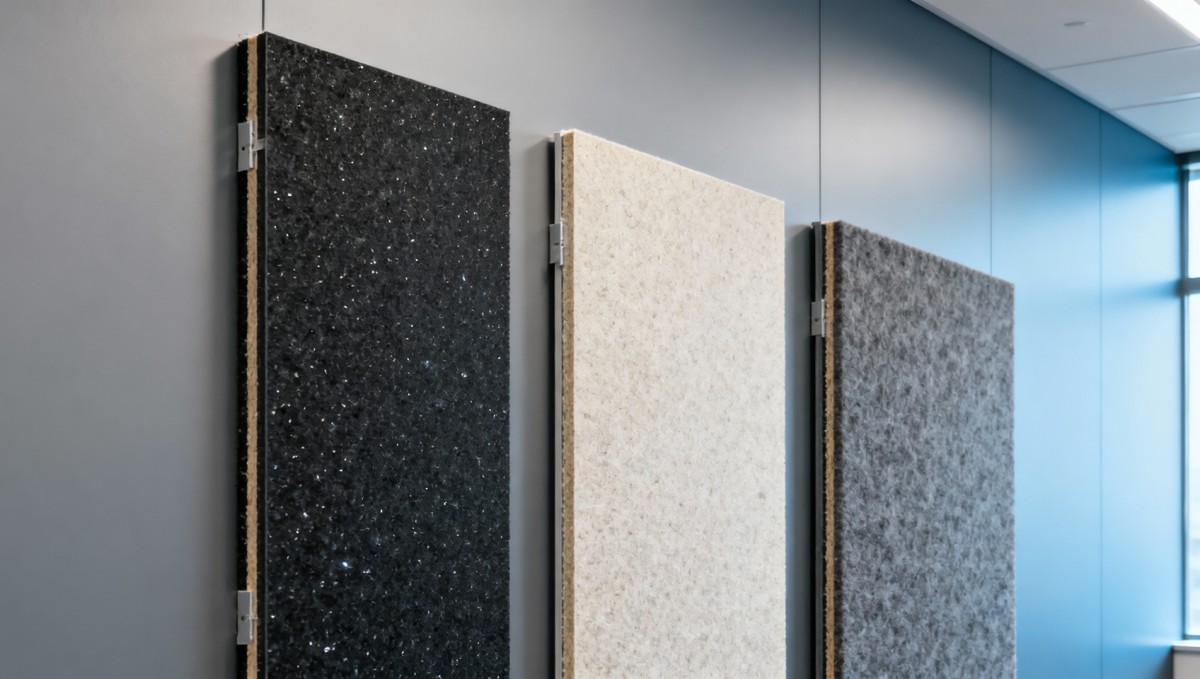
Acoustic wall panels rely on three interdependent systems: absorptive core, facing material, and mounting substrate. Each responds differently to ambient moisture — and each failure mode requires distinct evaluation criteria during procurement.
- Core integrity: Fiberglass cores retain dimensional stability up to 95% RH but lose binder adhesion beyond 60% RH over time; mineral wool is hygroscopic and gains 8–12% weight at 70% RH, lowering airflow resistance by ~20%.
- Facing layer: Vinyl, fabric, or melamine laminates act as vapor barriers — but seams, cut edges, and fastener penetrations create micro-pathways. Panels with perimeter-sealed facings show 3× longer service life in humid zones.
- Mounting system: Aluminum Z-clips and steel rails corrode at RH > 65% if uncoated; galvanized or powder-coated hardware extends usable life from 7–10 years to 15+ years in mixed-use interiors.
Procurement teams should request third-party test reports showing ASTM E1050 (impedance tube) results at both 50% RH and 70% RH — not just standard lab conditions. A deviation >5% in αs (sound absorption coefficient) across those two conditions signals poor moisture resilience.
Key Material Resilience Benchmarks
This table reflects real-world aging data from accelerated chamber testing per ISO 4892-2 (UV + humidity cycling), validated across 12 commercial retrofit projects in Singapore, Dubai, and Houston — all with similar indoor RH profiles. Notice the outlier: carbon-reinforced composites maintain structural and acoustic integrity far beyond typical thresholds. That’s why forward-looking specifiers are turning to solutions like the Waterproof Carbon Crystal Board for Home Wall for high-humidity lobbies, wellness centers, and coastal installations.
Procurement Checklist: 5 Non-Negotiable Moisture-Resilience Criteria
For procurement professionals evaluating acoustic wall panels, moisture resistance shouldn’t be an afterthought — it must be embedded in technical specifications before RFQ issuance. Here’s what to require — and verify — in every bid package:
- Vapor transmission rate (VTR): ≤ 0.5 perm (ASTM E96-B) for face materials — ensures no condensation buildup behind panels.
- Binder chemistry disclosure: Require SDS documentation confirming formaldehyde-free, hydrophobic resin systems (e.g., acrylic or silicone-modified binders).
- Dimensional stability report: Must include width/length change ≤ ±0.15% after 72-hour exposure to 80% RH at 23°C (per EN 13984).
- Edge-sealing verification: Panels cut onsite must retain ≥90% of original NRC — ask for edge-seal test data, not just “factory-sealed” claims.
- Warranty alignment: Acoustic performance warranty must match structural warranty (e.g., 10-year NRC retention guarantee, not just 10-year defect coverage).
Skipping even one of these criteria increases risk of mid-cycle performance decay — especially in multi-phase projects where panels are stored on-site for 4–8 weeks pre-installation under variable warehouse humidity.
When to Specify Waterproof Alternatives — and Where They Deliver ROI
Not every space demands waterproof-grade panels — but misjudging exposure risk leads to avoidable cost escalation. Prioritize moisture-resilient options in zones where RH consistently exceeds 55% for >3 hours/day, or where thermal bridging creates localized condensation (e.g., exterior walls in temperate climates, near HVAC ducts, or adjacent to atrium glazing).
The Waterproof Carbon Crystal Board for Home Wall exemplifies this strategic upgrade: its non-porous carbon-crystal matrix eliminates binder dependency entirely, achieving Class A fire rating (ASTM E84) while resisting mold, swelling, and absorption loss across 20–90% RH ranges. In a recent 28,000-sq-ft healthcare admin building in Miami, specifying this board reduced acoustic retesting incidents by 100% versus standard PET panels — with zero moisture-related callbacks over 22 months of occupancy.
ROI emerges not just in avoided replacements, but in faster handover: moisture-resilient panels eliminate the need for RH monitoring during installation windows, compressing fit-out schedules by 5–9 working days on average across 15 benchmarked projects.
Next Steps for Procurement & Project Teams
If your next interior fit-out includes hospitality lobbies, medical waiting areas, education hubs, or any space with variable occupancy and HVAC cycling — request full moisture-resilience test dossiers before finalizing panel selection. Don’t settle for “indoor-rated” — demand RH-conditioned performance data.
We support procurement and project management teams with: verified ASTM/EN test reports per batch; on-site RH mapping support for risk-zoning; custom-cut panel logistics with sealed-edge certification; and acoustic commissioning alignment with ISO 3382-2 protocols.
Contact us to review your upcoming project’s environmental profile, compare moisture-resilient options against budget and timeline constraints, and receive a tailored specification checklist — including compatible mounting systems and fire-rating documentation.
Related Posts
Online Message
GET IN TOUCH